

“We Get To Watch Miracles Happen”: Regional One, Hames family remember ordeal one year later
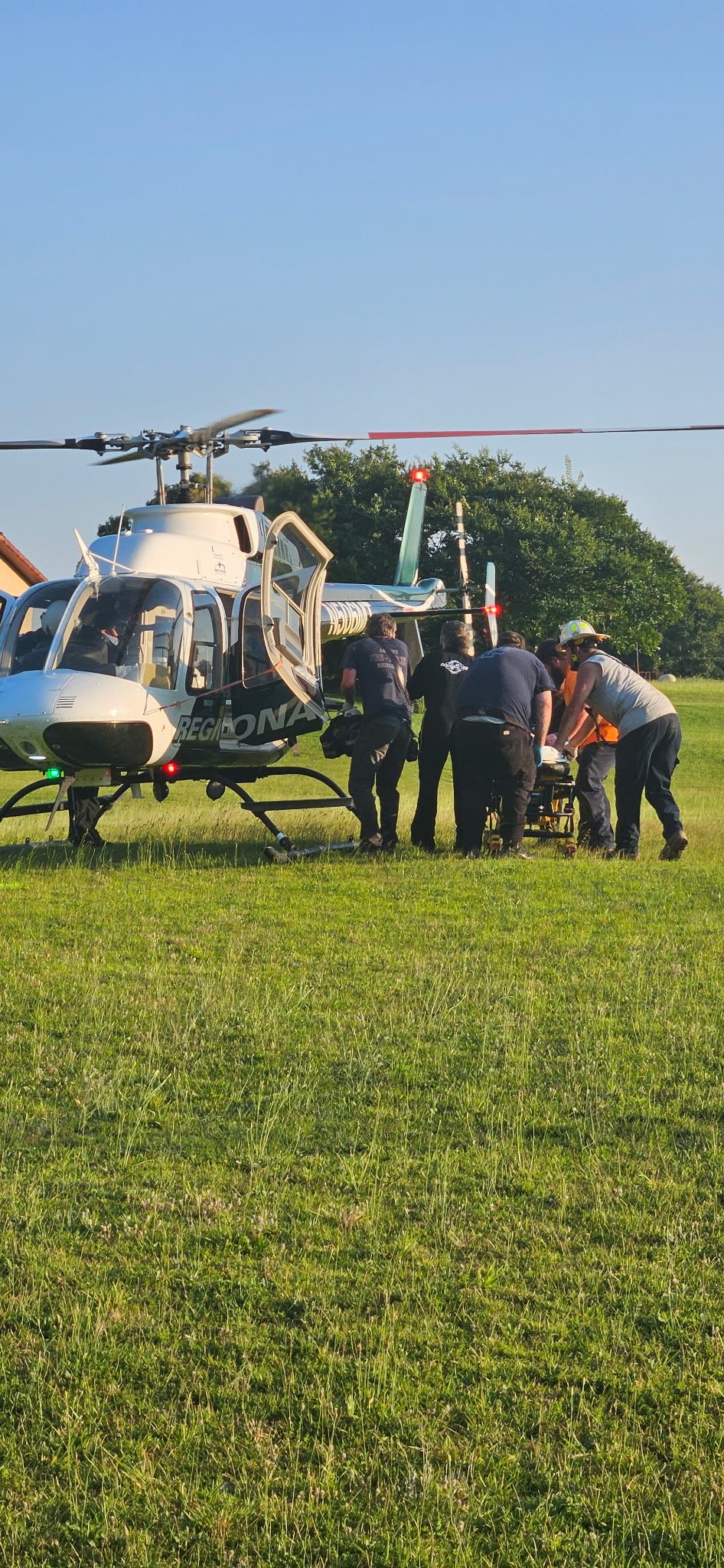
Regional One Air Medical Flight Medic Matthew Lonon doesn’t let much that he sees on the job bother him.
He can’t. He has to compartmentalize. He has to send it away.
“It’s how we deal with it,” Lonon said. “We push it to the side. You have to.”
But last summer, after treating Emilia Hames, Lonon couldn’t push it any further. So he made an exception.
“It didn’t bother me until the next day,” he said. “My daughter is six-years-old. At the time, Emilia was six. It didn’t bother me until I got home. Normally, I don’t let my kids hug me when I’m in my flight suit. My wife Nikki (also a paramedic) was telling her to stop. But I just let her hug me for a while. Because I didn’t think Emilia was going to make it, and I told Nikki I was afraid that there was a man who wasn’t going to get to hug his daughter tomorrow.”
Thanks to Lonon, Flight Nurse Jessica Mills, and Pilot Jim Biddle, Jesse Hames did get to hug his daughter. A year later, Emilia is thriving. Regional One is a huge part of the reason why.
“We’ve got to go NOW”
Mills remembers nearly every part of what she calls “a perfect flight”.
The urgency is what she remembers most.
Mills, a flight nurse on Regional One Air Medical, was on duty last June 26 along with Flight Paramedic Matthew Lonon and Pilot Jim Biddle. When they arrived at a call in Cherokee County, when they saw Emilia Hames’ broken body, when they were making instant mental calculations at the same time they were communicating with each other, Mills remembers one thing constantly hammering away at her mind.
“I just kept thinking we’ve got to go,” she said. “We’ve got to go NOW. I felt like I was going to vomit if we didn’t go. I felt like the Holy Spirit was telling me we had to.”
Going now is what Regional One is all about. It’s what the pilots and flight crews are trained to do day in and day out. But it’s only part of the operation.
It takes a lot to get Regional One in the air. There are a ton of factors at play in calling for the helicopter, the most important two being time and a need for critical care. As soon as a call is received, the crew quickly checks in with a safety-first mindset.
“In helicopter EMS, you have to be super safety-concerned,” Mills said. “So we come together - medic, pilot, and nurse - and we check in with each other. Have you eaten? Have you slept? Do you feel good? It’s three to go, and one to say no. If it just doesn’t feel right, we can say no.”
The crew accepted the call that day, and they were in the air quickly. Mills credits that to pilot Biddle.
“Biddle’s goal in life is to beat us to the helicopter,” she said with a laugh. “That way, we can shave off time.”
The crew seemed to shave off time at every turn on their trip last June. They were called very early on in the process. The landing zone, secured by firefighters on the ground at their destination, was perfect. The ambulance that was already on scene met the crew with Emilia, rather than them having to make it all the way to her.
That’s when Mills’ overwhelming feeling that they needed to be quick first started to kick in.
“When I first said that we needed to go, Matt agreed,” she said. “I told him to take Dad, and he got him tucked in and safety briefed. We loaded Emilia, and we went.”
From patient contact to leaving the scene of a transport, Mills said anything less than 10 minutes is a fast time. That day, Regional One left the landing zone in four.
“I’ve yet to do a scene time that quick,” she said.”
An Extensive List Of Injuries
What makes the quick turnaround even more remarkable is what the crew were facing that day - or more specifically, what Emilia was facing. Her mom, Kim Hames, had just completed her last day at Dorman’s youth softball camp after resigning earlier as the school’s softball coach. They celebrated with a Pelican’s snowball earlier in the afternoon, and when Jesse, Emilia, and the Hames’ oldest son Abram took off for a dirt bike ride, Kim elected for a power nap instead.
“My alarm had just gone off, and I stopped it,” she said. “Before I could put my phone down, my husband’s face popped up on my phone. He was frantic. He could barely get words out. He told me I had to get over to the neighbor’s house, because Emilia had been hit by a truck. You hear that, you’ve just woken up from a nap, and you wonder if it’s real. I got what I needed to get out the door as quick as I could, and went about a mile down the road.”
Emilia hasn’t been able to help the family with any of her own memories of the accident, but what they think happened is simple.
“We have a neighbor a couple miles down the road with a disabled wife and some health concerns,” Kim said. “Anytime he needs something, he asks Jesse for help, and he needed a hand with a tractor. They’d helped and were leaving, and Jesse and Emilia had already ridden across the road. Abram had turned his bike over coming down the 80-90 foot driveway, and couldn’t get it back up. So Jesse put Emilia off to the side of the road, and as he was helping our son, he heard a truck coming.”
Jesse looked up and yelled for Emilia to stay where she was.
“We think because she had her helmet on, she could see her Daddy yelling for her but couldn’t hear what he was saying,” Kim said. “So she assumed he was calling for her and came right across the road. The truck didn’t see her quite in time. The driver slowed down, but we’re not sure how much change that made in the result.”
The result was horrific.
“On scene, we already knew she had a lot of injury to her left leg,” Kim said. “It was clearly broken and there were two major lacerations on that side. You think that’s the most severe, because it’s a distracting injury. It looks horrible. She had a brain injury, a broken collarbone, broken ribs, her pelvis was broken in two places, the leg, and abrasions from the road rash where she tousled for 60 or so feet covering most of her body.”
Moments Make A Difference
Now, let’s take a look at those four crucial minutes that Regional One was on the ground. The crew didn’t know what they would find on the call, just that it was a dirt bike wreck that required critical care. They had no idea they would be treating a child. Both parents themselves, Lonon and Mills had to quickly push that fact aside and just react to another patient. They arrived so quickly that they were able to see Emilia.
“Half the time, they bring the patient in an ambulance into the landing zone,” he said. “But we were so quick getting there, I could see her still in the ditch.”
“I think it really hit home with both of us because we both have little kids,” Mills said. “I saw her, and it registered, but you have to put that aside. I just keep going back to the fact, and I’ve talked about it with Kim, that it was just perfect timing. That child never got in the back of an ambulance. She was being pushed up the hill to us as we landed.”
Those minutes saved, both said, were the product of early activation and an outstanding job by the support crew on the ground from Asbury Rehoboth Volunteer Fire Department and Thorne Ambulance Services.
“Early activation was huge,” Mills said. “Kim told us about how they’d watch the helicopters fly over, but that day a neighbor had activated us early. Jesse picked Emilia up and thought she was dead, and she gasped.”
Kim explained the timing of that activation even better.
“9-1-1 dispatched the local fire department, and the assistant chief had just passed the road,” she said. “Aaron Richardson was the first to arrive, and he was at Jesse’s side in 45 seconds, with another arriving shortly after. They dispatched Regional One. We’re no strangers to watching the helicopter fly over and feeling that rumble. But waiting there, you’ve never desperately wanted to see it appear so badly as in that moment.”
Once it appeared, Lonon said the group on the ground made sure everything went as well as it possibly could.
“They’re a huge key factor,” he said. “At hospitals we land on clean, concrete helipads. On scene, these guys go out and find us somewhere that’s 100 x 100 to land, and then they walk that field to make sure there’s no debris. It’s essential that they find it for us and prepare it. There are poles, wires, trees, but that day it was wide open. We landed, and there were already multiple guys making a wall. That’s our responsibility, and we were able to hand it off to them without having to worry about it.”
Instead, the crew was able to focus on their own responsibilities. And they decided quickly that as many of those that could be accomplished in the air, would be.
“I’m so glad Matt and I were in synch,” Mills said. “He asked about an IV, I said I’d do it in the air, he agreed. We barely even talked after that. It was just divide and conquer. We didn’t put her on a monitor until we were in the air. We’re trained really well, and you should be able to do your job sleepy, upside-down, and unfed. But in the moment, you can get in your own way. That wasn’t the case.”
After they loaded Emilia safely and got Jesse squared away in the helicopter, there was one last thing Mills needed to do. She pulled Kim aside and gave her what she calls her “mama talk”.
“I just told her that it wouldn’t help Emilia for her not to get there, and that we only have one helicopter so we couldn’t come and get her, and to promise me that she wouldn’t wreck, and wouldn’t speed,” Mills said.
Kim said it worked.
“I think it gave me a calmness overall,” she said. “It kept replaying over and over in my mind. There’s no sense in worrying. It’s not going to help anybody. Just lean on your faith and trust that she’s getting the care she needs.”
And with that, Mills hopped on board and Regional One was gone.
“We Get To Watch Miracles Happen”
As well as the rescue and flight went, the timing and importance of the small decisions that saved them time became evident as the helicopter’s skids touched down in Greenville. Emilia almost immediately had another emergency.
“As soon as we touched down, Emilia vomited and aspirated as we rolled into the trauma bay,” Mills said. “She could no longer oxygenate and had to be intubated, and it took a team of six or eight doctors to get that procedure done. We’d have had to do it in the air with the two of us. We’re trained to do those things, but praise God we didn’t have to do it that day.”
Lonon marvels at the timing that helped them avoid it.
“If they’d waited until the ambulance arrived to ask for us,” he said. “If anything at any point had made a difference of 30 seconds, it could be a different outcome.”
Even as they reached the hospital, the outcome was in doubt. Just like Lonon worrying about Emilia when he saw his own children, Mills was having doubts when she talked with her second Hames parent of the day.
“I had to pull Jesse out of the trauma bay,” she said. “I put my hands on his shoulders and I told him that Emilia was in the right place with the right people. And I haven’t told Kim this, but I thought I’d lied to him that day when I told him she was going to be ok.”
A few days later, she was proven wrong as well.
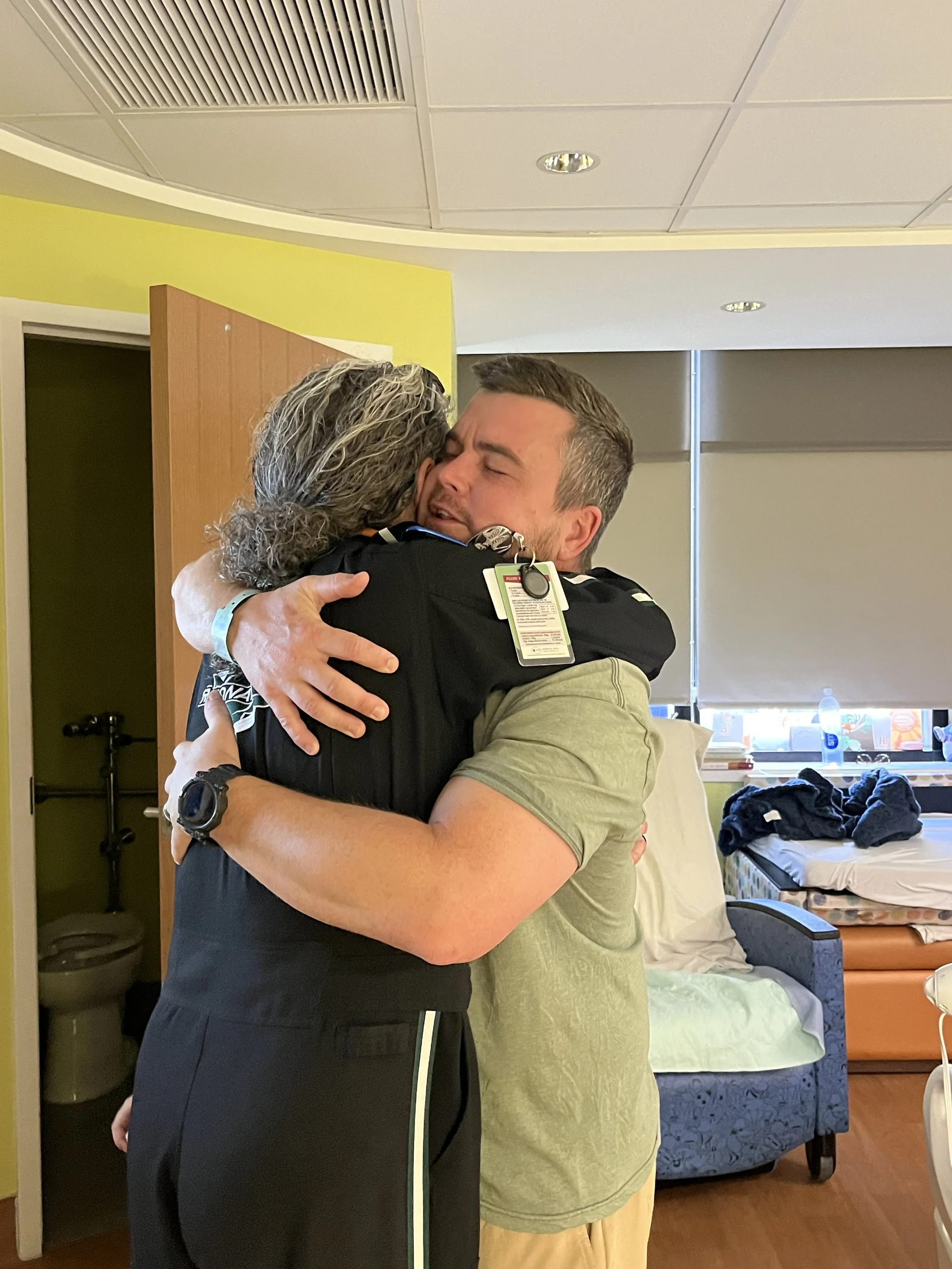
“Matt tore his calf, and was out for a while,” Mills said. “On one of my next shifts, I had a bag of goodies and said that if we went to Greenville, I was going to go try to see her. First flight, Greenville. So I went to Emilia’s room and she wasn’t there. I couldn’t believe she was out of the bed. I left those things, and I walked through the double doors of the PICU, and they walked in. I lost it. Jesse hugged me so hard I thought he’d choke me.”
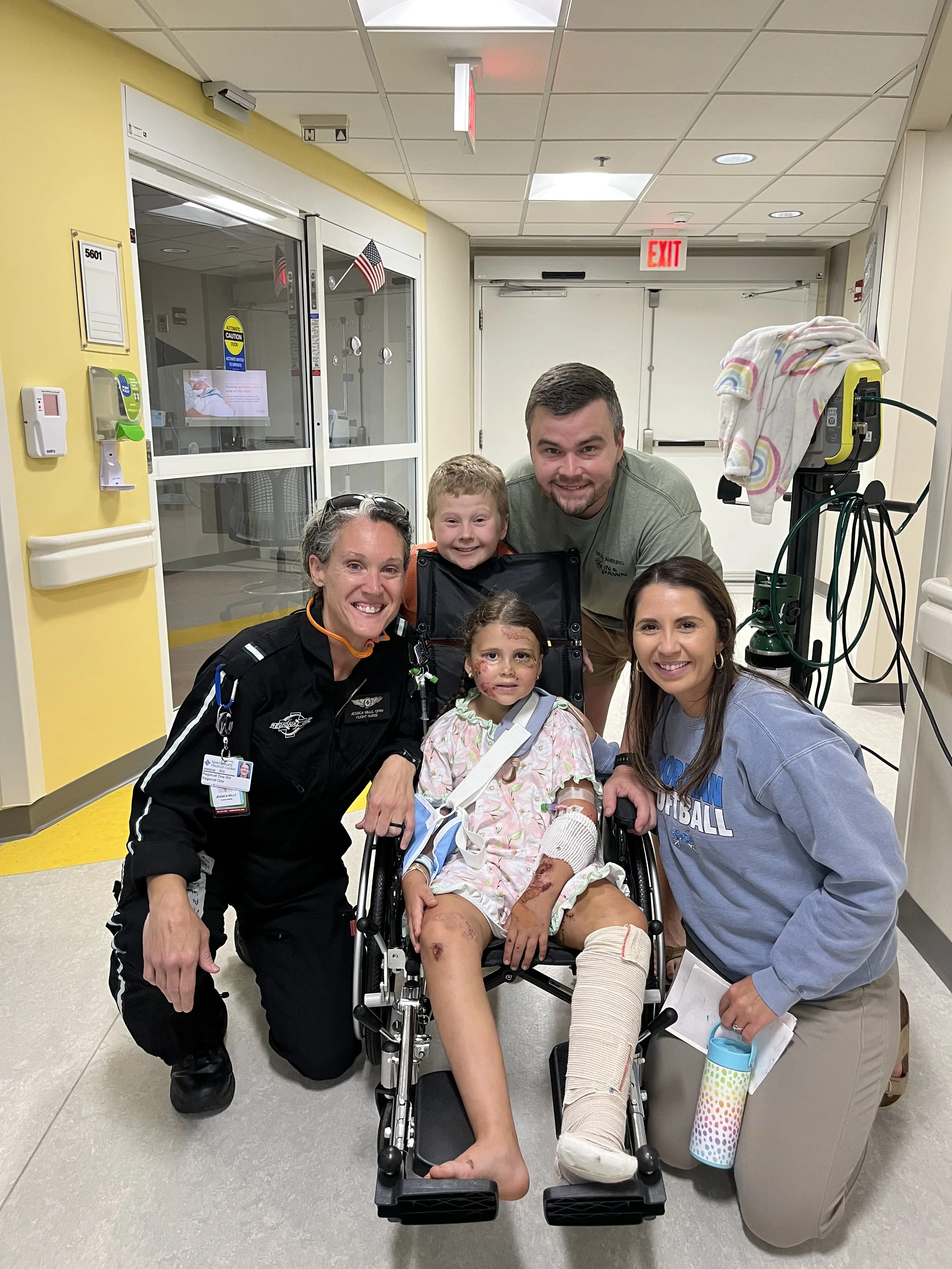
So how did the little girl whose injuries left a pair of flight professionals questioning her survival chances walk out of her hospital room so quickly?
Lonon, Mills, and the Hames family attribute it directly to faith.
“I knew that family was different from the way they handled themselves,” Mills said. “I felt a peace radiating off of them at the worst of the worst of times. Jesse nearly climbed out of the helicopter trying to get out of our way. And just everything that day went seamlessly. There’s always a little something that goes wrong. But we’ve replayed it over and over, and we couldn’t ask for anything to be different.”
Faith is a huge part of who Kim is. She said she feels like she had a chance to truly embrace that.
“It’s a reactive response,” she said. “You can’t really prepare for what you’ll feel or what you’re going to say. Is she hurt, what’s hurt, how severe is it? I think I saw my faith go into action immediately. You say you believe in the things you believe, but when tragedy strikes within a moment’s notice, you start depending on that strength for sure. I’ve been in seasons and situations where I had to be dependent on the Lord. Last year was one of those seasons, and I think I kind of wrestled with it a little bit. When Emilia’s accident happened, it gave great purpose to what we were going through. Do you really believe what you say you believe? I learned to depend on the Lord in a different way.”
A year later, Emilia is back on a bicycle, back on a dirt bike, back to living a normal little girl life. Her mother calls her fearless. Her flight nurse calls her amazing. Both use the same word for the process that delivered her from her injuries last year.
“I tell people we have the coolest job ever,” Mills said. "We get paid to watch miracles happen. Emilia’s the case that’s not supposed to be. And then to see folks like Jesse and Kim acknowledge what it is, is really special.”
Kim agrees completely.
“We didn’t really think we’d ever get to see a miracle physically with our own two eyes,” she said. “But we definitely can, for sure.”
She also continues to sing the praises of the flight crew. She wrote a letter in support of the crew’s nomination for a Stars of Life Honor, and she said the crew’s performance is something that still amazes her.
“I think as a parent you don’t often put your kid in the hands of strangers,” she said. “At that moment, we had no control over that. Handing over care of your child to someone you don’t really know, you hope they’d provide care and love and support as if it was their own. From the moment they got to the scene, it was evident that they were going to care for her just like they’d care for their own daughter. You could see that immediately just by the emotions on their faces. These people do this a lot. They see the worst of the worst. You’d think they’d become calloused to some of this. But these are real people with real feelings and emotions. They carry big burdens beside these families. I’m just so grateful that they treated her like she was their own.”
